Our Hybrid Agile Way — Because Balance Builds Better
Every project starts with an idea.
But between “let’s do this” and “it’s live”, there’s a journey — and that journey needs balance.
Too much freedom, and things go off-track. Too much rigidity, and creativity dries up.
That’s where Hybrid Agile comes in — a workflow that lets us stay structured and stay flexible at the same time.
At WeGeni, this isn’t a buzzword or a borrowed process. It’s simply how we work best.
Understanding the Hybrid Agile Concept — Made Simple
Imagine you’re building a big digital product.
You start with a solid plan — what to build, when, and how. That’s the Waterfall way: step-by-step, structured, and predictable.
But as work begins, things often shift — maybe users want new features or the market changes fast. That’s where the Agile way helps — it lets teams adapt, adjust, and keep improving as they go.
Hybrid Agile combines both.
- From Waterfall, it keeps the structure and accountability.
- From Agile, it borrows flexibility and quick learning.
At WeGeni, we plan with purpose but execute in flexible cycles — reviewing, refining, and improving continuously.
We don’t just build once — we build better every time.
How the Workflow Blends — The WeGeni Way
Let’s decode what happens behind the scenes.
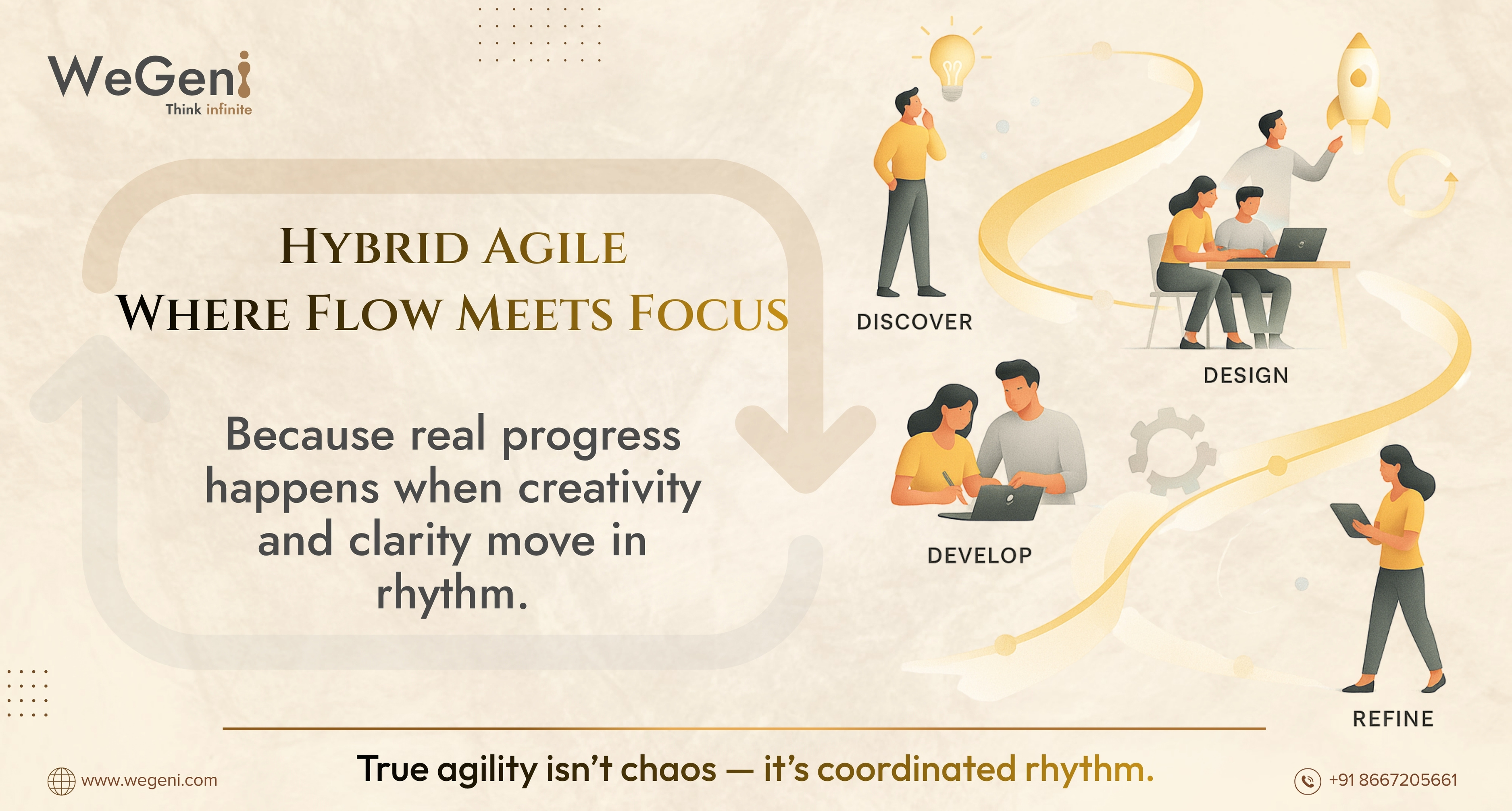
1. Discovery – Setting the Foundation
Every project starts with understanding the “why.”
We define goals, outline challenges, and map the journey ahead.
Here, the Waterfall mindset ensures clarity: timelines, dependencies, and expected outcomes are all laid out.
But we don’t lock the doors here. The Agile element allows us to revisit and tweak this foundation as we learn more.
2. Design – Visualising the Experience
Once direction is set, the creative gears turn.
Design isn’t just about aesthetics; it’s about empathy — how users feel, react, and flow through the solution.
Our teams brainstorm freely (the Agile energy), yet stay grounded in system logic and usability (the structured element).
Each concept passes through visual sprints, early validations, and refinements — so creativity and practicality evolve together.
3. Development – Building in Loops, Not Lines
Traditional methods build in long, linear phases. WeGeni builds in loops of learning.
Development happens in sprints — short cycles where modules are created, tested, and improved instantly.
Each sprint ends with measurable progress, reviews, and a plan for the next.
Still, the structured roadmap ensures that these sprints align with the final product’s direction — no drifting, no endless loops.
This is where the “hybrid” part truly lives — disciplined freedom.
4. Delivery – Measured, Tested, and Clear
In pure Agile, deployment often overlaps with development. In Hybrid Agile, we integrate structured sign-offs after each milestone.
That means the product evolves continuously, but each version passes through stability checks before it meets the user.
For clients, that translates to predictable timelines and zero surprises.
5. Refinement – Continuous Evolution
Even after delivery, we keep listening. Feedback isn’t an end note — it’s a cue for evolution.
WeGeni’s Hybrid Agile keeps a dedicated feedback loop open for refinements, performance tracking, and new iterations.
Because technology doesn’t stand still — and neither should solutions.
Why Hybrid Agile Works for WeGeni
At WeGeni, our projects often combine creativity with complex logic — from designing brand ecosystems to developing enterprise-grade tech solutions.
We needed a workflow that respects both imagination and method.
Hybrid Agile became that bridge — allowing us to:
-
Collaborate better: Clients, developers, and designers stay connected through clear checkpoints.
-
Adapt faster: When priorities shift, we realign without restarting.
-
Deliver smarter: Every stage has intent, every iteration adds value.
It’s not about rushing. It’s about rhythm — the steady pace between structure and spontaneity.
The Human Side of Hybrid Agile
Hybrid Agile isn’t just about tools and tasks — it’s about people.
It empowers teams to think, question, and create without chaos.
Designers know where their creative window begins and ends. Developers get flexibility without losing direction.
Managers have visibility without micromanaging.
It’s an ecosystem where clarity meets creativity — and progress feels human, not mechanical.
In Essence
Hybrid Agile is how WeGeni turns ideas into outcomes — faster, cleaner, and more adaptable.
It’s how we build not just projects, but partnerships.
Because the real power of Hybrid Agile isn’t in the process — it’s in the people who make it work.
And at WeGeni, that’s our strength — a team that thrives where structure meets evolution.