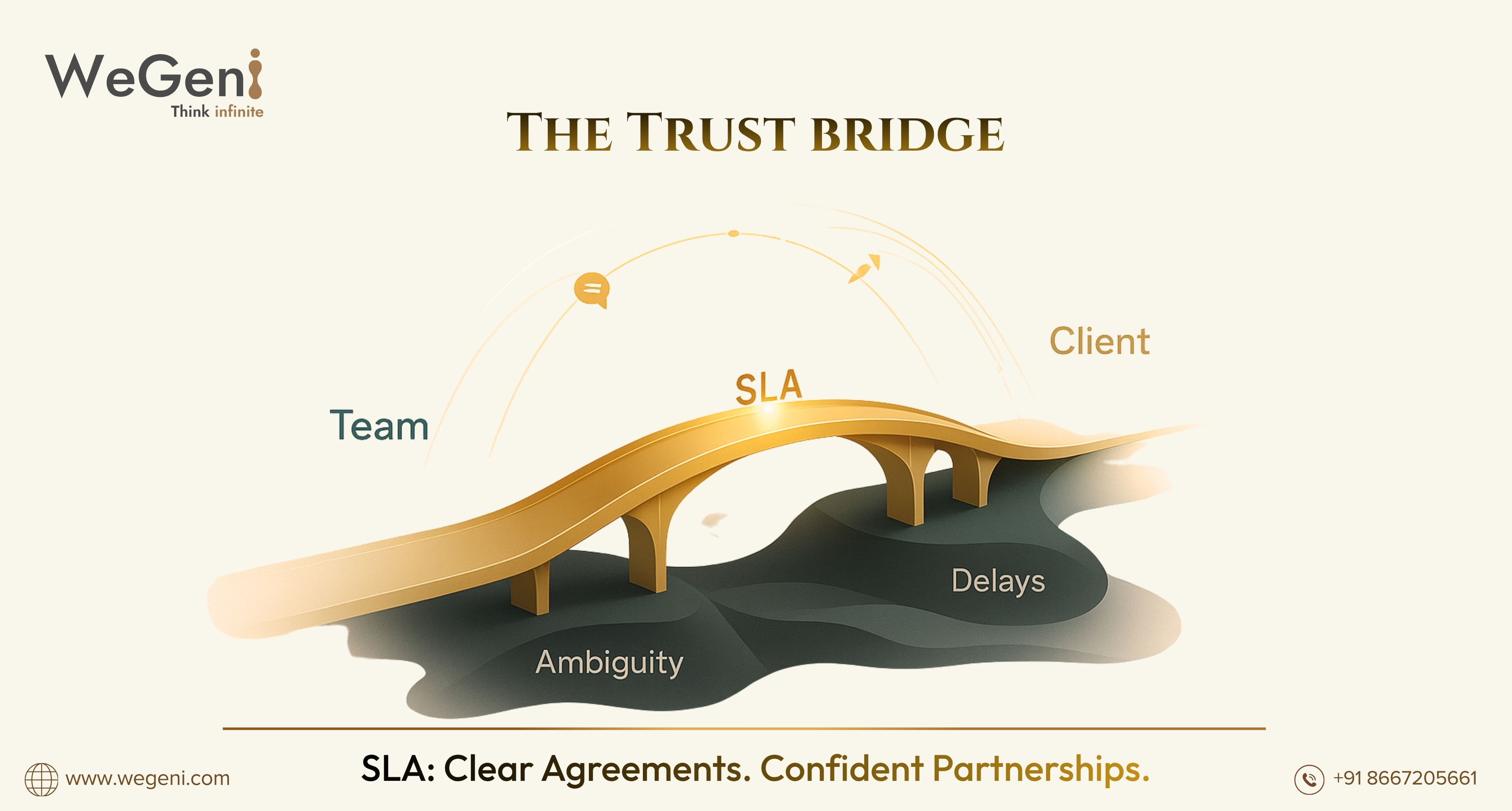
The Unseen Contract That Builds Trust Before the First Delivery
Imagine this: you’re about to start a partnership with a new tech or consulting company. The energy is high, goals are clear, and promises are made.
But the real question is — how do you ensure that expectations meet execution?
That’s where an SLA (Service Level Agreement) steps in — not as red tape, but as the invisible handshake that keeps both sides aligned.
At WeGeni, we don’t treat SLAs as paperwork. We treat them as performance compasses — guiding how we deliver, communicate, and evolve with every client we onboard.
1. SLA is the Foundation of Accountability
During onboarding, excitement often overshadows structure.
But without clarity, even the most promising partnerships can wobble.
An SLA defines what “good service” looks like:
-
Response Time — how fast we act when issues arise.
-
Resolution Time — how long it takes to close the loop.
-
Quality Standards — measurable parameters that assure delivery.
-
Escalation Matrix — who steps in and when.
It’s not about control — it’s about confidence.
When clients know what to expect and we know what to deliver, trust becomes measurable.
2. SLA Streamlines the Onboarding Process
Client onboarding is often a whirlwind of information — access sharing, goal setting, timelines, and expectations.
An SLA simplifies this by acting as a structured playbook.
At WeGeni, our SLA-driven onboarding involves:
-
Mapping client goals with deliverable timelines
-
Setting communication checkpoints
-
Aligning metrics of success
-
Defining flexibility clauses for change management
This ensures that both sides begin with clarity instead of assumptions, making the onboarding journey smooth, transparent, and efficient.
3. SLA Makes Collaboration Predictable and Scalable
When multiple teams — tech, design, marketing, or strategy — come together, things can get complex fast.
An SLA gives structure to that complexity.
WeGeni uses SLAs to ensure:
-
Every team understands their deliverables
-
Dependencies are documented
-
Workflow escalation paths are predefined
-
Reporting cadence is consistent
That predictability reduces friction and builds a system that can scale without chaos.
4. SLA Protects Both Sides — Clients and Teams
Here’s the human side of it:
An SLA isn’t about rigid enforcement; it’s about mutual respect.
It protects the client’s investment and the team’s bandwidth.
When expectations are well-defined:
-
Teams avoid burnout from last-minute surprises
-
Clients get assurance of consistent service quality
-
Feedback becomes structured, not emotional
At WeGeni, this structure ensures every partnership feels balanced and fair.
5. SLA Fuels Continuous Improvement
SLAs are not carved in stone.
They evolve with the project — especially in dynamic digital ecosystems where priorities shift.
We review SLAs periodically to:
-
Assess performance metrics
-
Identify process improvement areas
-
Redefine KPIs based on real-time data
-
Strengthen client communication loops
Because what works today may not fit tomorrow — and that’s okay as long as transparency drives evolution.
6. Real-Time Example: SLA in Action
During a recent digital transformation project, a client had an urgent need to scale their backend performance during a festival sale week.
Because our SLA had a “rapid escalation clause”, we were able to:
-
Mobilize our tech support in under 3 hours
-
Resolve performance bottlenecks within the agreed SLA window
-
Keep the client’s site uptime at 99.9%
That’s not luck — it’s the power of a well-engineered SLA.
Conclusion: SLA Is Not Paperwork — It’s Partnership DNA
At WeGeni, we don’t onboard clients; we onboard relationships.
And every strong relationship starts with clarity, trust, and structure — the very essence of a Service Level Agreement.
When SLA meets empathy, onboarding stops being a process and becomes an experience.
It’s not just about what we promise — it’s about how we perform, every single time.
✅ Key Takeaway:
A well-defined SLA transforms onboarding from “expectation setup” to “trust setup.”
It’s not about signing a deal — it’s about aligning on deliverables, outcomes, and growth.