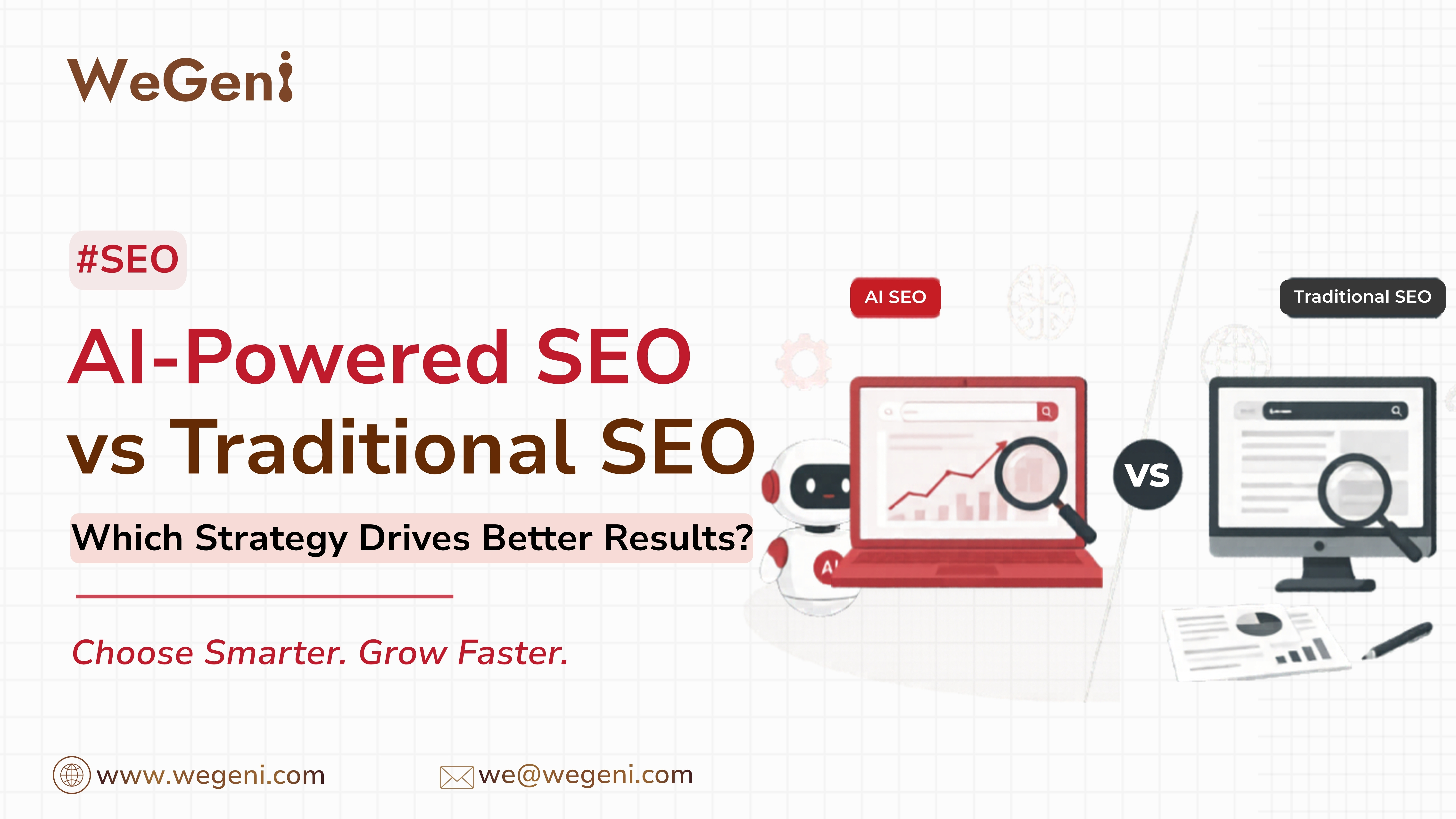
Stop Picking Sides. The Businesses Winning at SEO in 2025 Are Doing Both.
Everyone is talking about AI SEO. Almost nobody is asking the right question.
Not “Is AI SEO better?” — but: “Which one is actually making businesses more money right now?”
We have run both approaches across 150+ clients in 10 countries over the past two years. We have seen AI SEO save weeks of work. We have also seen it produce content so hollow it hurt rankings instead of helping them. We have seen traditional SEO build the kind of trust that compounds for years — and we have seen it move too slowly to keep pace with the market.
The truth is not what most people want to hear: the businesses winning in organic search right now are not choosing sides. They are combining both.
This blog breaks it all down — head to head, without the hype, with a 4-step hybrid strategy you can apply to your business today.
1. What Is AI SEO — and What Is Traditional SEO?
Before we compare, let’s be precise. These are not interchangeable terms — they describe fundamentally different approaches to the same goal: ranking higher on Google and bringing in qualified organic traffic.
|
AI SEO |
Traditional SEO |
|
Uses AI tools to generate content at scale, automate keyword research, and run technical audits in minutes. |
Uses human expertise, research, and strategy to build authority and trust over time. |
|
Tools include: Surfer SEO, Jasper, SEMrush AI, ChatGPT-based workflows. |
Tools include: manual keyword research, human-written content, link building, and structured technical audits. |
|
Speed advantage: weeks of work done in hours. |
Depth advantage: nuanced, authoritative content Google's E-E-A-T signals reward. |
|
Best for: rapid scaling, competitive gap analysis, large content volumes. |
Best for: high-trust niches, professional services, long-term brand authority. |
Neither is new. AI-assisted SEO has been around in various forms since at least 2018 — what has changed is the quality, accessibility, and speed of the tools. Traditional SEO, meanwhile, has simply evolved. It is no longer just “write good content and get backlinks.” It now demands genuine expertise, real-world proof, and a level of authenticity that AI tools alone cannot manufacture.
2. The Honest Data: What We Saw Across 150+ Clients
Here is what our client work has consistently shown across service businesses, e-commerce brands, SaaS companies, and professionals in India, the UK, the UAE, and beyond:
|
Metric |
AI SEO Approach |
Traditional SEO Approach |
|
Time to publish 20 blog posts |
3–5 days |
6–8 weeks |
|
Avg. ranking improvement (6 months) |
Moderate — fast initial gains, then plateau |
Slower start, stronger sustained growth |
|
Google E-E-A-T compliance |
Requires significant human editing |
High — built-in with expert-led content |
|
Content engagement (avg. time on page) |
Lower — readers sense the generic tone |
Higher — richer, more trust-building content |
|
Technical audit speed |
Hours (AI wins clearly) |
Days to weeks |
|
Cost efficiency for scaling |
Very high |
Moderate to high |
|
Long-term authority building |
Limited without human layer |
Strong |
|
Risk of Google penalty (SGE/Helpful Content) |
Higher if AI content is unedited |
Low — when done properly |
|
WEGENI INSIGHT: Clients who used AI SEO alone saw strong initial traffic lifts — sometimes 40–60% in 90 days. But without the human expertise layer, many of those gains eroded within 6 months as Google’s algorithm updates refined their preference for genuinely helpful, experience-backed content. Clients running a hybrid model held their gains and continued compounding. |
3. Where AI SEO Wins — Undeniably
Let’s give credit where it is due. For specific, high-volume tasks, AI SEO tools are genuinely transformative. If your business is not using them, you are working harder than you need to.
Speed of Content Production
A 25-page content strategy that once took two weeks to research and draft can now be outlined, keyword-mapped, and first-drafted in under 48 hours using AI tools. For businesses that need to cover a wide content surface quickly — think e-commerce category pages, FAQ clusters, or localisation at scale — this is a genuine competitive advantage.
Technical SEO Audits
AI-powered tools can crawl an entire website, identify broken links, flag duplicate content, analyse page speed issues, and map keyword gaps against competitors — all in a fraction of the time a manual audit takes. If you are not auditing your site with AI-assisted tools, you are leaving easy wins on the table.
Keyword Clustering and Gap Analysis
Modern AI tools can group thousands of keywords into topical clusters, identify exactly what your competitors are ranking for that you are not, and map the user intent behind each search — at a depth that would take human researchers weeks to replicate.
Content Repurposing and Scaling
AI can turn one well-researched piece of content into ten: a blog post becomes a LinkedIn series, an FAQ page, a YouTube script, and a social carousel. For businesses with strong source content, AI repurposing dramatically multiplies the return on every piece you create.
4. Where Traditional SEO Still Wins — and Why It Matters More Than Ever
Here is the uncomfortable truth that some AI SEO evangelists are glossing over: Google’s algorithms are getting better at detecting, and devaluing, content produced by AI without authentic human expertise.
The 2023–2025 Helpful Content Updates were explicit about this. Google does not penalise AI content outright — it penalises content created primarily to rank, rather than to genuinely help the reader. A lot of unedited AI SEO content falls squarely into that category.
E-E-A-T: The Signal AI Cannot Fake
Google’s E-E-A-T framework (Experience, Expertise, Authoritativeness, Trustworthiness) rewards content that signals real-world knowledge. Author bios with credentials, first-person case studies, original data, and genuine opinions — these are things an AI tool cannot manufacture authentically. They require a human who has actually done the work.
Link Building and Digital PR
High-quality backlinks remain one of the strongest ranking signals Google uses. And the best backlinks — from reputable publications, industry blogs, and news sites — are earned through real relationships, genuine expertise, and content that journalists and editors actually want to cite. AI cannot build these relationships for you.
High-Trust, High-Stakes Industries
If you are a lawyer, a doctor, a financial advisor, a CA firm, or any professional in a trust-dependent field, your audience is not just looking for information. They are evaluating whether they can trust you with their livelihood, their health, or their money. Generic AI content will actively work against you in these sectors. Human-authored, experience-backed content is not optional — it is your competitive moat.
Local SEO and Regional Authority
For Indian businesses serving specific cities, districts, or communities, local SEO success depends on signals that are deeply human: Google Business Profile management, local citations, community mentions, and content that genuinely reflects local knowledge and context. AI tools can support this work, but they cannot replace the regional insight that drives real local authority.
5. The Businesses That Lost Ground — and Why
Over the past two years, we have seen a clear pattern emerge among businesses that committed fully to one approach and ignored the other.
|
Went All-In on AI SEO Only |
Stayed Purely Traditional |
|
Published 100+ AI-generated posts in 6 months. Traffic spiked, then collapsed after Helpful Content Update. |
Fell months behind competitors on content volume and keyword coverage. |
|
Content ranked briefly for long-tail terms, then lost position to more authoritative competitors. |
Lost ground to AI-assisted competitors who covered 10x more keyword surface area. |
|
Audience engagement was low. High bounce rates signalled poor content quality to Google. |
Slower to respond to algorithm changes and new search trends. |
|
Brand credibility took a hit as readers noticed the generic, impersonal tone. |
Higher cost per piece of content limited scaling in competitive markets. |
The lesson is consistent: choosing one and ignoring the other is a strategy for losing ground, not gaining it.
6. The Hybrid Model: What Is Actually Working in 2025
The businesses growing fastest in organic search right now are not debating AI vs traditional. They are using AI to do more of the right things, and human expertise to make every decision that actually matters.
We call this the Hybrid SEO Model, and here is exactly how we implement it with clients:
|
Step |
What We Use AI For |
What Requires Human Expertise |
|
Strategy & Research |
Keyword clustering, competitor gap analysis, search intent mapping at scale. |
Business goals alignment, audience insights, brand positioning, topic prioritisation. |
|
Content Creation |
First drafts, structural outlines, FAQ generation, title variations. |
Expert editing, adding real-world experience, E-E-A-T signals, brand voice, original data. |
|
Technical SEO |
Site audits, crawl error detection, page speed analysis, schema suggestions. |
Prioritising fixes, interpreting results in business context, resolving edge-case technical issues. |
|
Link Building & PR |
Identifying outreach targets, drafting initial outreach templates. |
Relationship building, pitch personalisation, digital PR strategy, editorial negotiation. |
|
THE 4-STEP HYBRID STRATEGY: Step 1: Use AI to map your full keyword universe and identify gaps. Step 2: Prioritise topics based on business value and ranking difficulty — human decision. Step 3: Use AI for first drafts, then edit deeply for expertise, experience, and authenticity. Step 4: Build authority through human-led link acquisition and digital PR. |
This is not a complicated model. But it requires resisting the temptation to let AI do all the thinking, and resisting the instinct to dismiss AI tools as shortcuts. The businesses getting this right are treating AI as a powerful execution accelerator — not a strategy replacement.
7. Which Approach Is Right for Your Business Type?
Not every business has the same SEO needs. Here is a practical framework to help you decide where to lean:
|
Business Type |
Recommended Approach |
Why |
|
E-commerce (100+ products) |
AI-heavy hybrid |
High content volume, competitive keyword surface, speed matters. |
|
Professional services (law, finance, health) |
Human-led hybrid |
E-E-A-T critical; trust and authority are the competitive moat. |
|
SaaS / B2B tech |
Balanced hybrid |
Technical content needs human expertise; volume can be AI-assisted. |
|
Local service business |
Traditional-led hybrid |
Local SEO needs human context and community connection. |
|
D2C / Consumer brand |
AI-heavy hybrid |
Content volume and repurposing drive growth; brand voice needs human editing. |
|
Startup (0–1 year old) |
Traditional-led hybrid |
Authority building from scratch requires genuine expertise signals. |
|
Established brand (5+ years) |
AI-heavy hybrid |
Existing authority allows safe scaling with AI-assisted content. |
How WeGeni Helps You Get This Right
WeGeni is a full-service digital solutions company based in Tiruchengode, Tamil Nadu — built to help Indian businesses, professionals, and entrepreneurs grow their digital presence with intention and precision.
Our SEO work is built on the hybrid model. We use the best AI tools to move faster and smarter, and we bring human expertise to every strategic decision, every piece of content, and every link-building relationship.
- SEO Strategy & Keyword Research — Full keyword universe mapping, competitor analysis, and content roadmap tailored to your business goals.
- AI-Assisted Content Creation with Expert Editing — We use AI tools to scale your content output, and our editors ensure every piece meets Google’s E-E-A-T standards.
- Technical SEO Audits — Comprehensive site audits with clear, prioritised action plans to fix what’s hurting your rankings.
- Link Building & Digital PR — Human-led relationship building with Indian and international publications to earn backlinks that genuinely move rankings.
- Local SEO — Google Business Profile optimisation, local citations, and region-specific content for businesses serving local markets.
- SEO Reporting & Analytics — Monthly reports that connect organic search performance directly to business outcomes — traffic, leads, and revenue.
|
WEGENI TIP: Not sure where your current SEO stands? Book a free SEO audit with the WeGeni team. We’ll show you exactly where you are losing ground, where the quick wins are, and how to build a sustainable organic growth strategy for your business. Visit wegeni.com/contact-us to get started. |
Conclusion — Stop Debating. Start Combining.
The AI vs traditional SEO debate is the wrong conversation to be having in 2025. It is a false choice that distracts from the only question that actually matters: how do I build a sustainable, compounding source of organic traffic that my business owns?
The answer is not AI. It is not purely traditional. It is a deliberate, well-executed combination — where AI tools accelerate your execution and human expertise ensures every piece of that execution is built on real authority, real experience, and real value for your audience.
The businesses ignoring this are either publishing AI slop that Google is actively devaluing, or they are spending five times as much time producing content that could be created in a fraction of the time with better tools.
The businesses getting it right are compounding. Every month, they rank for more terms, earn more backlinks, and build more trust with both Google and their audience. That compounding effect is what turns SEO from a cost into one of the highest-return investments in your marketing mix.
Start where you are. Audit your current SEO position. Identify where you are losing ground to competitors. Choose the hybrid model that fits your business type. And build it with the discipline and expertise it deserves.
Ready to Build an SEO Strategy That Actually Works?
Talk to the WeGeni team for a free SEO audit. We’ll show you exactly where you stand, where your competitors are beating you, and how to build an organic growth engine that compounds over time.
Frequently Asked Questions — AI SEO vs Traditional SEO
Q: Will Google penalise my website for using AI-generated content?
Not automatically — but it will devalue content created primarily to rank rather than to genuinely help readers. Google’s Helpful Content framework is explicit about this. AI-generated content that is unedited, generic, and lacking in real-world expertise is at significant risk of ranking losses. AI content that has been carefully edited, enriched with genuine expertise, and published under a credible author is treated the same as any high-quality content.
Q: How much of our SEO should we automate with AI tools?
A useful rule of thumb from our client work: use AI freely for research, auditing, outlining, and first drafts. Never publish AI content without meaningful human editing. Never let AI make strategic decisions about which topics to prioritise, how to position your brand, or how to build your authority. Strategy and expertise remain irreducibly human.
Q: How long does it take to see results with a hybrid SEO approach?
Most clients running a properly executed hybrid strategy begin to see measurable ranking improvements within 60–90 days, driven by the AI-assisted technical fixes and quick content wins. Sustained organic traffic growth, the kind that compounds and continues building, typically takes 6–12 months. SEO is a long-term investment — the businesses that treat it as one are the ones whose growth becomes genuinely defensible.
Q: Is traditional SEO dying because of AI?
No — and this is one of the most persistent misconceptions in digital marketing right now. Traditional SEO’s core principles — authority, trust, relevance, and genuine helpfulness — are more important than ever. What is dying is the low-effort, high-volume approach to content that never required expertise in the first place. The bar has been raised, not lowered. Genuine expertise has become more valuable, not less.
Q: How can WeGeni help with our SEO strategy?
WeGeni offers end-to-end SEO services built on the hybrid model — from strategy and keyword research to AI-assisted content creation, technical audits, link building, and monthly reporting. Whether you are starting from scratch or trying to recover lost rankings, our team builds SEO strategies that are designed to compound. Visit wegeni.com/contact-us to book a free audit.