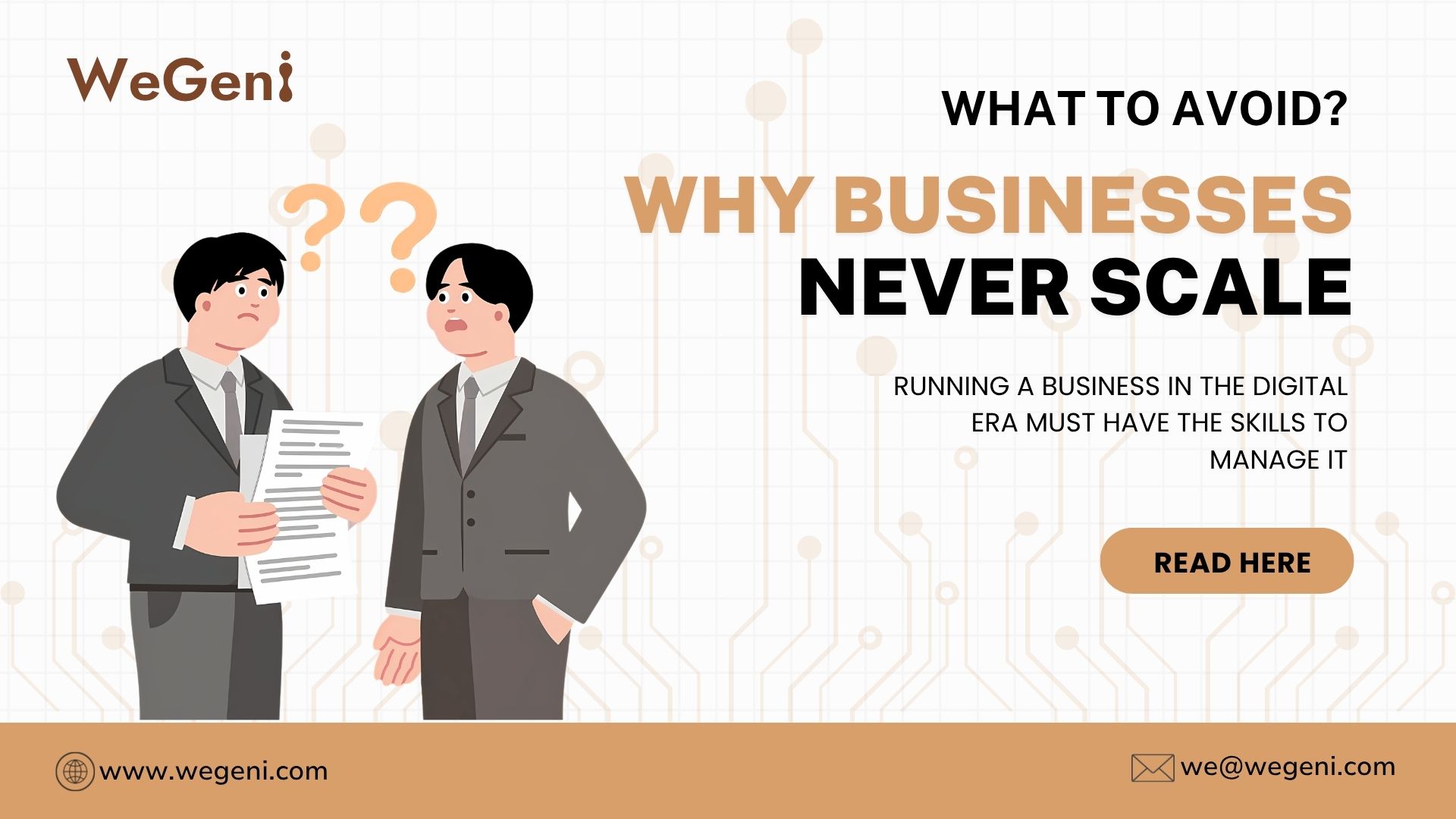
The Hidden Reason Your Business Stalls Before It Scales
Your product is good. Your team is working hard. Revenue is moving. But something feels off — delivery is slipping, your calendar is exploding, and decisions that used to take minutes now take days. You are growing. So why does it feel like things are getting harder, not easier?
This is one of the most common — and most misunderstood — experiences in business. And the answer is rarely the market, the product, or the team. Most of the time, it is the way the business is scaling.
Scaling the wrong way costs more than not scaling at all. At WeGeni Consulting, after working across industries with founders, B2B leaders, and growing businesses, we see the same three mistakes appear repeatedly — across different sectors, different sizes, and different markets.
This blog breaks them down — what they are, why they happen, how they hurt your business, what the research says, and how to fix them before they become expensive.
Most scaling failures are not market failures. They are structural failures — problems that were always there, which growth simply made impossible to ignore.
Why Scaling Goes Wrong: The Numbers
Before we go into the mistakes, it helps to understand just how common scaling failure is — and what is driving it.
|
Scenario / Reality Check |
Impact |
Stat / Source |
|
Startups that fail to scale past early-stage growth |
~78% |
McKinsey, 2023 |
|
Business failures attributed to poor strategy, not poor product |
Over 65% |
CB Insights |
|
Founders who cite "doing too much myself" as a scaling barrier |
7 in 10 |
Harvard Business Review |
|
Businesses using data-driven decisions that outperform competitors |
23× more likely |
McKinsey |
|
SMBs that lack documented processes for core operations |
Over 60% |
Deloitte Insights |
|
Revenue growth in businesses with clear documented strategy vs without |
2× faster |
Gartner |
These are not outliers. They reflect a pattern that plays out across industries every day. And the good news is — every one of these is fixable, once you know what to look for.
Mistake 01 | Chasing Growth Without Strategy
You are saying yes to every client. Launching new offerings. Entering new markets. Adding headcount. The pipeline is full. But behind the scenes, the operations are straining. Customer experience is inconsistent. Margins are compressing. The team is busy — but unclear on what actually matters most this quarter.
This is what happens when a business chases growth without a documented, aligned strategy. Movement gets mistaken for progress. Revenue milestones get celebrated while structural foundations quietly erode.
How This Mistake Happens
Most founders and business leaders are wired for action. Early-stage businesses survive on speed and opportunism — saying yes fast, moving before competitors, iterating quickly. Those instincts are right for survival mode.
But scaling mode requires a different operating system. When you are scaling, you are no longer building a product or finding your first customers. You are building a machine — a system that can deliver consistent value, at volume, without you personally holding it together.
Without a clear strategy, that machine never gets built. Every decision is made in isolation. Every opportunity is evaluated without a framework. The team pulls in different directions, each member doing their best — but toward different definitions of success.
What It Actually Costs
|
✗ What Most Businesses Do |
✓ What Scalable Businesses Do |
|
Opportunities evaluated by gut feel and urgency |
Opportunities filtered through documented strategic criteria |
|
New hires added reactively as problems appear |
Team expanded proactively, with clear roles aligned to growth goals |
|
Multiple projects running with unclear priorities |
Focused execution on 3–5 high-impact initiatives per quarter |
|
Customer experience varies by who delivers it |
Consistent delivery because the process — not the person — drives quality |
|
Revenue grows but margins shrink |
Revenue grows with improving unit economics |
Current Trends: Strategy-Led Scaling in 2025
The most competitive businesses in 2025 are using Objectives and Key Results (OKRs) frameworks — popularised by Google and now adopted widely across B2B companies of all sizes — to keep strategy visible, measurable, and team-aligned. Tools like Notion, ClickUp, and Monday.com have made strategy documentation accessible even for lean teams.
The shift: Strategy is no longer a document you write once a year and file. It is a live, shared operating system that every team decision references daily. Businesses that build this rhythm scale consistently. Businesses that don't, stall.
The Fix
You do not need a 40-page strategy document. You need clarity on four things:
- Who you serve — your specific, defined target market or customer segment.
- What you offer — your core value proposition and how it differs from alternatives.
- How you grow — your primary revenue and acquisition model.
- What you prioritise — your 3–5 measurable goals for the next 90 days.
Write it down. Share it with your team. Review it monthly. Adjust it quarterly. That simple rhythm will do more for your scaling journey than any tactical campaign or tool you invest in.
A clear strategy is not a luxury. It is the infrastructure that makes everything else work.
Mistake 02 | Doing Everything Yourself
The founder reviews every proposal before it goes out. Every hire clears through them. Every client issue lands on their plate. The team is capable — well-trained, well-intentioned — but nobody moves without a sign-off.
The business is growing in revenue but not in capacity. The leader is the best operator in the room. And that is exactly the problem.
Why This Is So Common
Founders build businesses from scratch. They develop deep expertise across every function — sales, delivery, operations, finances — because in the early days, they had to. That involvement was not just useful. It was essential.
But as the business scales, that same involvement becomes a ceiling. When the founder is the quality control, the decision-maker, and the escalation point for every problem — the business cannot operate faster than one person can work. And one person, no matter how talented, has 24 hours in a day.
Harvard Business Review calls this the "founder's trap" — the transition from being the business's best operator to building a team that operates better without them present in every decision is one of the hardest leadership shifts to make, and one of the most essential for scaling.
How It Shows Up Day-to-Day
- Team members wait for approvals instead of acting within their authority
- Response times slow as leadership becomes the bottleneck for every decision
- Founder's calendar has no white space — every hour is consumed by internal operations
- Good team members leave because they feel micromanaged and underutilised
- Clients experience delays because delivery depends on one or two key people
- The business cannot take on more clients without the founder working more hours
The Real Cost: Revenue Left on the Table
When the founder is the bottleneck, the business has an invisible capacity limit. It cannot onboard a new client while the founder is handling an issue with an existing one. It cannot launch a new offering while the founder is approving content. It cannot grow the team while the founder is interviewing every candidate.
This is not a time management problem. It is a systems problem. And no productivity tool, calendar optimisation, or motivational framework will fix it. Only two things will: delegation and documented processes.
Current Trends: How Scalable Teams Are Built in 2025
The most scalable businesses in 2025 are building what organisational design experts call "team-of-teams" structures — small, empowered units with clearly defined authority and shared goals, rather than centralised hierarchies where everything flows through leadership.
They are investing in Standard Operating Procedures (SOPs), asynchronous communication tools (Loom, Notion, Slack), and internal wikis that make institutional knowledge accessible to everyone — not locked inside the founder's head. They are hiring leaders, not just executors. And they are measuring team performance on outcomes, not activity.
The Fix
Start with an audit. For one week, track every decision, task, or approval that required your direct involvement. Then ask honestly: which of these could be handled by a team member with the right training and a documented process?
The answer is almost always: most of them.
- Document the top 10 recurring tasks or decisions in your business.
- Build a simple SOP for each — even one page per process is enough to start.
- Assign ownership to a team member with the authority to act.
- Create a clear escalation framework — what decisions need leadership, and what do not.
- Review and coach, not approve and correct.
Your goal as a leader is not to be involved in everything. Your goal is to build a business that performs excellently — whether or not you are in the room.
Delegation is not giving up control. It is the only path to scale.
Mistake 03 | Ignoring Data and Feedback
The KPI dashboard exists. The customer feedback form is live on the website. The monthly report gets generated and shared. But none of it is actually changing how decisions get made. Strategy is still driven by what leadership feels is right, what the loudest client says, or what the competition appears to be doing.
This is the most quietly damaging of the three mistakes — because it is the hardest to see from the inside. Businesses that ignore data and feedback do not feel like they are ignoring it. They feel like they are moving fast, trusting their experience, and responding to what matters.
But they are building on assumptions. And assumptions, at scale, become very expensive.
Why Leaders Ignore Data (Even When They Have It)
- Data is collected but not reviewed in a structured cadence — it sits in dashboards nobody opens
- Feedback from customers or team members is treated as noise or negativity, not intelligence
- KPIs are tracked, but not connected to decisions — they are reported, not acted on
- Leaders are too close to the business to see the patterns the data is revealing
- There is no culture of asking "what does the data say?" before making strategic choices
The Real Cost: Compounding Errors
A single gut-led decision going wrong is recoverable. But a pattern of gut-led decisions — product features built for the wrong segment, pricing models that compress margins, team structures that create friction — compounds into something that takes months or years to reverse.
According to McKinsey, data-driven businesses are 23 times more likely to acquire customers, 6 times more likely to retain them, and 19 times more likely to be profitable than their less analytically driven competitors. The gap is not marginal. It is structural.
Businesses that ignore feedback from their customers face a parallel risk. A study by Bain & Company found that 80% of companies believe they deliver superior customer experience — while only 8% of their customers agree. That gap does not close without a systematic feedback loop.
How This Plays Out When Scaling
|
✗ What Most Businesses Do |
✓ What Scalable Businesses Do |
|
Expanding into a new market based on founder's intuition |
Expanding based on customer demand data, pilot results, and market analysis |
|
Pricing set by comparing competitors' public-facing numbers |
Pricing modelled on actual customer willingness-to-pay research |
|
Team performance assessed through observation and feeling |
Team performance tracked through agreed KPIs and regular structured reviews |
|
Customer feedback collected but rarely reviewed or actioned |
Feedback reviewed monthly, patterns identified, product/service adjusted quarterly |
|
Strategy adjusted when something visibly breaks |
Strategy reviewed quarterly against KPI performance with structured pivot criteria |
Current Trends: Data-Led Scaling in 2025
The rise of affordable business intelligence tools has democratised data access for businesses of all sizes. Platforms like Google Looker Studio, HubSpot, Zoho Analytics, and Power BI allow even lean B2B teams to build real-time dashboards tracking revenue, pipeline, team performance, and customer satisfaction — without enterprise-level budgets.
AI-powered analytics tools are now summarising performance trends, flagging anomalies, and even suggesting strategic adjustments — giving founders and leadership teams faster, sharper insight with less manual effort.
The businesses scaling fastest in 2025 are not necessarily the best-funded ones. They are the ones that make the fewest wrong decisions — because they are the most informed.
The Fix
You do not need a data science team. You need three things:
- A small set of meaningful KPIs — typically 5 to 8 that directly measure your growth, delivery quality, and customer satisfaction. Less is more.
- A review cadence — weekly for operational metrics (pipeline, delivery timelines, support issues), monthly for strategic metrics (revenue, margins, retention).
- A feedback loop — a simple, regular system for collecting and reviewing customer and team feedback, with a process for acting on patterns.
The discipline is not in having the data. It is in reviewing it regularly, asking the honest questions, and being willing to change course when the numbers demand it.
Fast decisions feel efficient. Informed decisions are. The fastest businesses are the ones that make the fewest corrections.
Quick Reference: The 3 Mistakes at a Glance
|
# |
Mistake |
What It Costs You |
|
Mistake 1 |
Chasing Growth Without Strategy |
No plan → wasted resources, team confusion, inconsistent delivery |
|
Mistake 2 |
Doing Everything Yourself |
Founder bottleneck → growth ceiling, team underperformance, burnout |
|
Mistake 3 |
Ignoring Data and Feedback |
Gut decisions → costly corrections, missed opportunities, slow adaptation |
What Sustainable Scaling Actually Looks Like
Avoiding these three mistakes does not mean slowing down. It does not mean adding bureaucracy or hiring consultants for every decision. It means building the right foundation — so that when you accelerate, the business can actually handle it.
The businesses that scale sustainably — the ones that grow revenue without growing chaos — share a consistent pattern:
- They make strategy visible — documented, shared, reviewed, and connected to every major decision.
- They build systems, not dependencies — so the business performs consistently regardless of who is in the room.
- They let data lead — reviewing KPIs and feedback regularly, and adjusting strategy based on evidence, not assumption.
These are not complicated concepts. But they require discipline, intentionality, and — often — an outside perspective to see clearly. When you are inside the business every day, the patterns are hard to spot. The bottlenecks become invisible. The data goes unread because there is always something more urgent.
That is exactly where the right consulting support makes the most difference — not by doing the work for you, but by helping you see the business clearly and build the structures that make growth sustainable.
Growth Is a Strategy Choice
Scaling your business is one of the most rewarding things you can build. It is also one of the most demanding. The three mistakes in this blog are avoidable — but avoiding them requires honest self-assessment, a willingness to let go of what worked in the early stage, and the discipline to build systems before you need them.
The businesses that scale are not the loudest, the fastest, or the best-funded. They are the most intentional — clear on strategy, deliberate in how they build their team and systems, and honest about what the data is telling them.
If your business is scaling — or getting ready to — the best investment you can make right now is in the clarity you need to do it right. The right structure turns effort into results.
Ready to scale without the mistakes?Let's build the strategy, systems, and clarity your business needs to grow sustainably. 📩 business@wegeni.com |
Frequently Asked Questions
What is the number one mistake businesses make when scaling?
Based on our consulting experience, the most common is chasing growth without a documented strategy. When businesses scale without strategic clarity, every new client, hire, or market entry adds complexity without direction — leading to delivery gaps, margin pressure, and team misalignment.
How do I know if I am a bottleneck in my own business?
Common signs include: decisions waiting on your approval, team members asking for guidance on tasks they should own, your calendar having no white space, and the business slowing down when you are unavailable. If any of these are true, you are the bottleneck — and delegation and process documentation are the fix.
What KPIs should a scaling business track?
The right KPIs depend on your model, but most B2B businesses scaling effectively track: Monthly Recurring Revenue (MRR), Customer Acquisition Cost (CAC), Customer Lifetime Value (CLV), Net Revenue Retention (NRR), gross margin, pipeline velocity, and team productivity metrics. The key is to track fewer KPIs more consistently — not more KPIs occasionally.
How can a small business build a data culture without a big team?
Start small. Pick 5 KPIs that matter most to your business. Set up a simple dashboard using a free tool like Google Looker Studio or your existing CRM reporting. Block 60 minutes every month to review them with your leadership team. Act on what you see. Culture is built through repeated behaviour, not through investment in tools.
When is the right time to get business consulting support?
The right time is before the problem becomes a crisis. Most businesses reach out to consulting support when a scaling issue has already become visible — delivery is breaking down, the team is overwhelmed, or revenue has plateaued. Getting strategic support earlier — while things still seem to be working — is always more efficient and less expensive than fixing a structural problem at scale.
How does WeGeni Consulting help businesses scale?
WeGeni Consulting offers Business 360, Operations 360, and Strategy consulting — covering growth planning, process design, team structure, and performance systems. We work with B2B businesses to identify structural weaknesses before they become scaling failures, and to build the clarity, systems, and strategic frameworks that make sustainable growth possible. Reach us at business@wegeni.com or visit wegeni.com.